
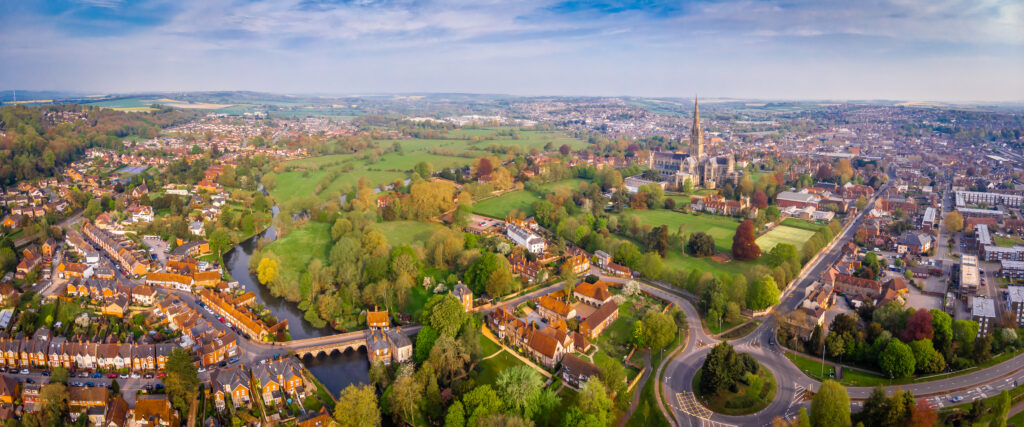
Salisbury and Wiltshire: Where England Still Works Its Magic
There’s a special kind of magic about Wiltshire that quietly ambushes you. It
doesn’t trumpet its charms like the Cotswolds or parade about like Bath. No,
Wiltshire sidles up, puts a gentle arm around your shoulder, and says, “Let’s just
slow things down a bit, shall we?”
Now, technically, many of our guests tell us they’ve “never been to Wiltshire,” but
when pressed, they sheepishly admit they have stood at Stonehenge, looking
bewildered at its giant megaliths like they were trying to solve a 5,000-year-old
Rubik’s Cube. Yet so many miss the true magic that begins just a few miles down
the road.
Stonehenge and Salisbury: A Day Made for Dreaming
Your perfect Wiltshire day should, of course, begin where mankind’s fascination
with time itself seems to have started: Stonehenge. With a private visit, you can
wander among the stones before the tour buses arrive, breathing in the sheer
weight of history (and possibly a little mist). It’s the kind of place where even the
most committed sceptic starts thinking in hushed tones.
And just when you think things couldn’t get more profound, you drive a mere 15
minutes into the heart of Salisbury. Here, the enchantment deepens.
Salisbury Cathedral is one of those places where time feels almost elastic. The
moment you step through the great wooden doors, the modern world simply,
obligingly, falls away. Everything slows to a dawdle. You don’t walk here; you
amble. You drift. And it’s not by accident. This is a place designed to make you
look up and wonder.
The cathedral houses what is (probably) the oldest working clock in the world. It
doesn’t even bother with a face much too modern but watching it chime into
life once a day is mesmerizing, like seeing a giant’s pocket watch shudder back
into being. You don’t need an engineering degree to be charmed into a state of
wide-eyed amazement.
And then there’s the dipstick. Yes, truly. Beneath a secret floor tile, the cathedral
hides a simple wooden dipstick, an ancient yet effective method of checking the
water levels under the building, because Salisbury Cathedral, in its infinite
medieval wisdom, was built on a floodplain. Lifting that tile and peeking in feels
deliciously conspiratorial, as if you’ve stumbled upon a sacred rite.
And then there’s the Magna Carta, one of the best-preserved original copies in
existence, quietly housed in a softly lit chapter house. You can stand nose-to-
nose with one of the foundational documents of democracy while feeling that
curious tingle that only true history can deliver. And the spire! England’s tallest,
impossibly elegant, soaring like a pencil sketch against the sky. You half expect it
to scribble notes among the clouds.
As you drift through the cloisters, sunlight tumbling through stained glass in
every conceivable shade, it’s impossible not to think: the world really isn’t such a
bad place after all.
Mompesson House: A Regency Daydream
Wandering just a few steps from the cathedral brings you straight into a Jane
Austen novel. Mompesson House stands there, graceful and serene, like an elder
aunt who’s seen it all and still approves of you.
Austen novel. Mompesson House stands there, graceful and serene, like an elder
aunt who’s seen it all and still approves of you.
Inside, they have laid out a Regency world so vividly that you half expect a young
gentleman in breeches and cravat to saunter through offering tea. Writing desks
stand ready for letters of breathless romance. The scent of beeswax and history
hovers in the air.
The families who lived here were a fascinating lot. There’s a deliciously English
whiff of genteel decline to it all, the dowager Portman, decanted from her grand
estate to smaller quarters; unmarried daughters squabbling amiably over tea
trays. It’s all terribly civilised.
Arundells: Secrets Behind Quiet Walls
If Mompesson is a Regency daydream, Arundells is a glorious peek into modern
history. This was the home of Sir Edward Heath, Prime Minister and inveterate
sailor, art collector, and international negotiator. And here’s the thing: it hasn’t
been tarted up for visitors. It still feels like he just popped out for a stroll.
Photographs with Castro and Churchill jostle for space alongside Lowrys and
Singer-Sargents. There’s a quiet dignity to it, a sense that here was a man who
lived fully, yet valued a place to breathe. The gardens alone, two rolling acres
with secret river views are worth an afternoon’s idling.
Wilton House: History You Can Touch
And just when you think Wiltshire can’t possibly have any more tricks up its
sleeve, Wilton House waits. Just a ten-minute drive from Salisbury, it’s an
absolute jewel.
Home to the Earls of Pembroke for over 450 years, Wilton is the sort of place that
makes you question whether anyone really needs that many Van Dycks (spoiler:
you absolutely do). The Double Cube Room is one of the finest rooms in England,
and even if you can’t tell a Doric column from a hatstand, you’ll be floored by the
sheer splendour.
The history here isn’t stiff or dusty; it’s alive. Shakespeare’s players performed in
the great halls, kings plotted in the salons, and lords and ladies flirted
outrageously under the watchful gaze of ancestors’ portraits. The house still
breathes with the life of centuries past. Even the gardens, laid out by Capability
Brown himself, seem to invite you to lose your way just a little, an invitation
that’s impossible to resist.
Outside, Capability Brown’s gardens unfurl like a green sea. Stroll over the
Palladian Bridge, past parterres, past reflective pools, and you’ll half-expect a
Georgian poet to leap out from behind a hedge reciting sonnets.
And you’ve probably already seen Wilton House, if not in The Crown, then in
Pride and Prejudice or Bridgerton but nothing beats the real thing, with the
breeze in your hair and the peacocks possibly judging your footwear.
A Racecourse with Champagne Charm
Now, if you happen to visit during racing season, the tiny Salisbury Racecourse is
a hidden joy. It’s gloriously intimate you can almost smell the turf and the
hospitality is nothing short of splendid. Private boxes with white-gloved service,
clinking glasses of Champagne, and that peculiar frisson of excitement as the
horses thunder past within arm’s reach. This is not your average day at the races.
hospitality is nothing short of splendid. Private boxes with white-gloved service,
clinking glasses of Champagne, and that peculiar frisson of excitement as the
horses thunder past within arm’s reach. This is not your average day at the races.
River Adventures: Drift Your Cares Away
Or, for those whose idea of excitement runs more to the soporific, there’s the
river. Climb aboard a luxury river launch and let Salisbury’s countryside drift by
at a pace so gentle it’s practically horizontal. The willows trail their fingers in the
water, the herons pretend not to notice you, and all you have to do is sip your
Pimm’s and sigh happily.
Where to Stay: The Finishing Touch
All this magic deserves somewhere special to lay your head.
For those who like a proper country house, there’s Lainston House
(https://www.exclusive.co.uk/lainston-house/) an elegant, sprawling mansion
just 40 minutes away. Think ivy-clad walls, crackling fires, and food that could
convince you to relocate permanently.
If you’d like to pair Wiltshire’s charm with a bit of Somerset’s finest, there’s The
Newt (https://thenewtinsomerset.com) 55 minutes from Salisbury and a
delicious blend of cider orchards, exquisite gardens, and a hotel so divine it might
actually make you weep.
awaits. It’s a place of treehouses, spa days, and gracious living, perfect if you want your
English adventure to end with the sea singing you to sleep.
Final Thoughts
Wiltshire isn’t about box-ticking. It’s about drifting, dreaming, and discovering
that England still has corners where beauty matters, where time slows down, and
where a good cathedral cloister or a perfect Palladian bridge can, for just a
moment, make the whole world feel right again.
Come for the stones, stay for the magic.