
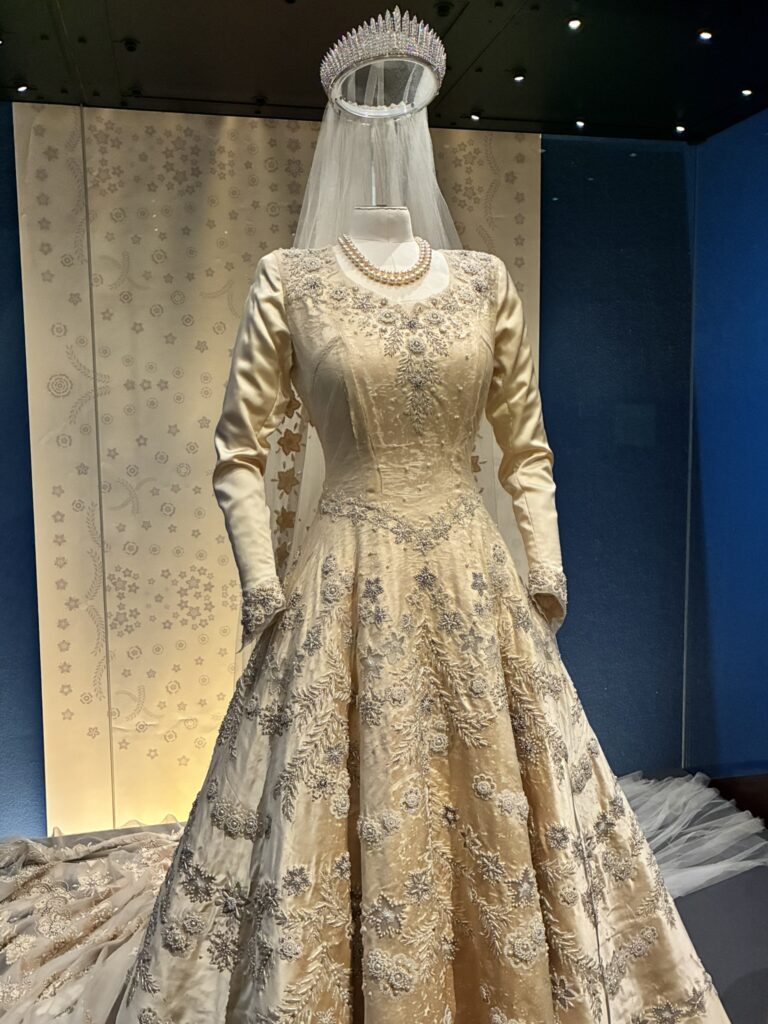
I walked into Queen Elizabeth II: Her Life in Style expecting to admire beautiful clothes.
I left feeling as though I had walked, quietly and unexpectedly, through the life of a woman who understood something far greater – that what she wore was never simply fashion, but a language. A way of showing up. Of serving. Of being seen.
And perhaps nowhere is that more striking than in a photograph from 1956.
Two women stand opposite each other. One is Marilyn Monroe, shimmering in gold, every inch the Hollywood bombshell. The other is Queen Elizabeth II, in black – structured, elegant, unapologetically composed.
And yet, your eye goes to the Queen.
It’s an extraordinary moment. Not because she outshone Marilyn – although she did – but because it reveals something deeper. Even then, in her twenties, she understood the quiet power of presence. Of restraint. Of choosing exactly how to be seen.
That understanding threads its way through the entire exhibition.
You begin with the softness of childhood – a tiny bridesmaid’s dress, all frills and bows, impossibly delicate. Then, almost without noticing, you move into the post-war years and the work of Norman Hartnell. His silhouettes – influenced by Christian Dior’s “New Look” – celebrate a young woman stepping into her role: full skirts, impossibly small waists, embroidery so intricate it feels almost unreal up close.
Her wedding dress stops just stopped me in my tracks.
Not because of its fame, but because of its detail. Thousands of tiny beads and pearls, stitched with such precision that you find yourself leaning in, instinctively slowing down. It’s impossible not to wonder how she felt that day – not just as a bride, but as a woman already carrying the weight of a future she could not yet fully know.
And then the story shifts.
The gowns become tools of diplomacy. Colours are chosen with care. Embroidery begins to carry meaning. Every detail is considered, not for spectacle, but for respect – a quiet nod to the countries she visited, the people she met, the role she fulfilled.
This is not fashion as indulgence.
This is fashion as duty.
Later, with the guidance of Angela Kelly and the quiet brilliance of Stewart Parvin, something changes again. The wardrobe becomes bolder, lighter, more luminous. Colours brighten. Silhouettes soften. There is, unmistakably, a sense of joy.
Parvin once said that she often chose the more daring designs – the ones you might not expect. And you see it everywhere. A flash of lime green. A coat that glows against a grey sky. Clothes designed not just to be elegant, but to be seen.
Because she understood something essential:
If people had come to see her, they should be able to see her.
And so, even her umbrellas – those wonderfully practical, transparent domes created by Fulton Umbrellas – were designed with care, trimmed to match her coats so that nothing, not even the British weather, would stand between her and the people she served.
And yet, for all this precision and discipline, there are moments where something else shines through.
A flicker of mischief. A quiet, perfectly judged sense of humour.
Don’t we all remember the moment during the 2012 London Olympics Opening Ceremony? Having been collected by James Bond, the Queen appeared to parachute from a helicopter hovering over the Olympic stadium to launch the 2012 London games. On display are two dresses – one worn by the Queen herself, the other by the stunt double, adapted to accommodate the parachute.
It was a moment that could have felt improbable, even absurd.
And yet, it was perfect.
Because it revealed something rarely spoken about, but deeply felt – that behind the formality was a woman who understood timing, theatre, and the quiet joy of surprising people. A monarch secure enough in her role to play with it, just a little.
But for me, the most moving part of the exhibition was not the grandeur.
It was the countryside.
There is a section filled with tweeds, headscarves, riding jackets – the quiet uniform of a woman entirely at ease. You see her not as a monarch, but as someone who loved the land deeply. The texture of Harris tweed. The familiarity of a well-worn scarf from Burberry. The practicality of boots made for muddy paths and long days outdoors.
This is where she feels most real.
At Balmoral. On horseback. Walking through heather and mist. Laughing, perhaps, at a family barbecue hosted by her beloved husband, Prince Philip, Duke of Edinburgh.
And it’s here, more than anywhere else, that you begin to understand something quietly profound.
For all the grandeur, all the ceremony, all the extraordinary moments captured in silk and sequins – this was a woman who found her greatest sense of self not in palaces, but in the countryside.
That connection – to land, to tradition, to people – is woven through everything she wore.
And perhaps that is why this exhibition feels so much more than a celebration of style.
It is a portrait of a life lived with intention.
A reminder that craftsmanship matters. That detail matters. That how we show up in the world matters.
And, in its own quiet way, it captures something we hold very close at Humphreys.
Because when you travel through the British countryside, what you are really discovering is not just places, but stories. Traditions. People who have spent a lifetime perfecting their craft. Moments that don’t always announce themselves, but stay with you long after you’ve left.
The Queen understood that instinctively.
She didn’t just represent Britain.
She revealed it – carefully, thoughtfully, beautifully – one outfit, one moment, one encounter at a time.
That’s why I walked out of the Kings Gallery with a big smile on my face.